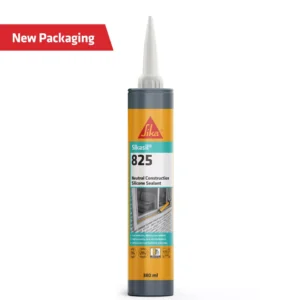
Grab adhesive and silicone sealant are two of the most commonly used products on building and renovation sites, and they are frequently confused with one another. Both come in cartridges, both are applied with a gun, and both bond materials together. But they are designed for very different purposes, and using the wrong one for a job can lead to a weak fixing, a failed finish, or a surface that needs to be stripped and redone.
This guide explains what each product is designed to do, where the differences matter, and how to choose the right one for the job in front of you.
What is grab adhesive?
Grab adhesive is a high-strength construction adhesive designed to bond materials together without the need for mechanical fixings such as screws, nails, or brackets. The name refers to its initial grab, which is the speed at which the adhesive grips the surfaces on contact and holds them in place while the full cure develops.
Grab adhesives are typically solvent-based or water-based polymer formulations. The key properties that make them useful on construction sites are:
- High initial tack: the adhesive grips immediately on contact, reducing or eliminating the need to prop or clamp the workpiece while it cures
- High final bond strength: once fully cured, a quality grab adhesive creates a structural bond that can support significant loads
- Gap filling: most grab adhesives have some gap-filling capability, allowing them to bond surfaces that are not in perfect contact
- Versatility: grab adhesives bond a wide range of materials including timber, plasterboard, MDF, concrete, brick, metal, and most plastics
Grab adhesives are not sealants. They do not flex significantly once cured, they are not waterproof in the way that silicone is, and they are not designed to fill or seal a joint against water ingress. Their job is to fix one surface to another.
What is silicone sealant?
Silicone sealant is a flexible, waterproof sealing compound designed to fill and seal joints between surfaces rather than bond them structurally. Silicone cures to a rubber-like finish that remains flexible throughout its service life, which allows it to accommodate movement in the joint without cracking or losing its seal.
The key properties of silicone sealant are:
- Flexibility: silicone remains elastic once cured, stretching and recovering with joint movement
- Waterproofing: properly applied silicone creates an airtight and watertight seal at the joint
- Adhesion to smooth surfaces: silicone bonds well to glass, ceramics, UPVC, and other non-porous materials where grab adhesives can struggle
- Temperature resistance: silicone maintains its properties across a wide temperature range, making it suitable for both indoor and outdoor applications
Silicone is not a structural adhesive. It has some bonding capability, but it is not designed to carry loads or replace mechanical fixings. Using silicone as a grab adhesive will typically result in a joint that fails under stress.
Key differences at a glance
Understanding where the two products diverge makes choosing between them straightforward in most situations:
- Bond type: grab adhesive creates a rigid structural bond; silicone creates a flexible seal
- Load bearing: grab adhesive can support weight; silicone cannot be relied upon for structural loads
- Flexibility: silicone remains flexible after cure; most grab adhesives do not
- Waterproofing: silicone provides a waterproof seal; grab adhesive does not
- Surface compatibility: silicone performs better on smooth non-porous surfaces such as glass and ceramic; grab adhesive performs better on porous or textured surfaces such as timber and plasterboard
- Cure time: grab adhesives typically achieve working strength faster; silicone requires a full cure before the joint is exposed to moisture
When to use grab adhesive
Grab adhesive is the right choice when the primary requirement is a strong, permanent bond between two surfaces. Common applications include:
- Fixing skirting boards, architrave, and coving without nails
- Bonding insulation boards to walls or ceilings
- Fixing timber battens to masonry
- Installing stair nosings or floor transitions
- Mounting mirrors, panels, or heavy decorative elements where drilling is not possible
- Fixing plasterboard to timber or metal studwork as a complement to screws
For any application where the bond needs to carry load or resist pulling forces, grab adhesive is the appropriate product. Browse our full range of grab adhesives to find the right product for your job.
When to use silicone sealant
Silicone is the right choice when the primary requirement is sealing a joint against water, air, or draughts, and where that joint is likely to experience movement. Common applications include:
- Sealing the perimeter of baths, shower trays, and basins
- Sealing around window and door frames on both interior and exterior applications
- Filling the joint between wall tiles and floor tiles
- Sealing around pipework penetrations
- Glazing applications including secondary glazing and conservatory panels
- Sealing around kitchen worktops at the wall upstand
In all of these situations, the joint will move over time as the building settles, as temperatures change, and as fixtures are used. A rigid adhesive in these locations would crack under that movement. Silicone accommodates it. Browse our full sealants range for the right product.
Can you use both together?
Yes, and in some situations using both together is the right approach. A common example is fitting a bath panel or a large mirror. The grab adhesive provides the structural fixing and holds the item in place under load, while a bead of silicone around the perimeter provides the waterproof seal and a neat finished edge.
In this kind of hybrid application it is important to apply the products in the right order. The grab adhesive goes on first to fix the panel or surround in place. Once it has achieved sufficient cure, the silicone bead is applied around the perimeter and tooled off neatly. Applying silicone first and then trying to fix over it does not work, because the silicone will prevent the grab adhesive from making contact with the substrate.
Choosing the right product for the job
The simplest way to decide is to ask what the joint or fixing needs to do:
- If it needs to hold something in place under load, use grab adhesive
- If it needs to stay watertight and accommodate movement, use silicone
- If it needs to do both, use grab adhesive for the fixing and silicone for the seal
Within each category, the specific product choice depends on the surfaces involved, the environment, and the performance requirements. For outdoor or wet area applications, check that the product is rated for those conditions. For sensitive surfaces such as natural stone or certain plastics, check compatibility before applying.
Where to source grab adhesive and silicone for trade
The Mastic Shop supplies a full range of grab adhesives and silicone sealants from trusted trade brands, at wholesale pricing with nationwide delivery. Whether you need a high-grab construction adhesive for a large fixing job or a sanitary silicone for bathroom finishing work, you will find the right product in our range.
If you need advice on the right product for a specific application, get in touch with our team and we will be happy to help.